Back to Blog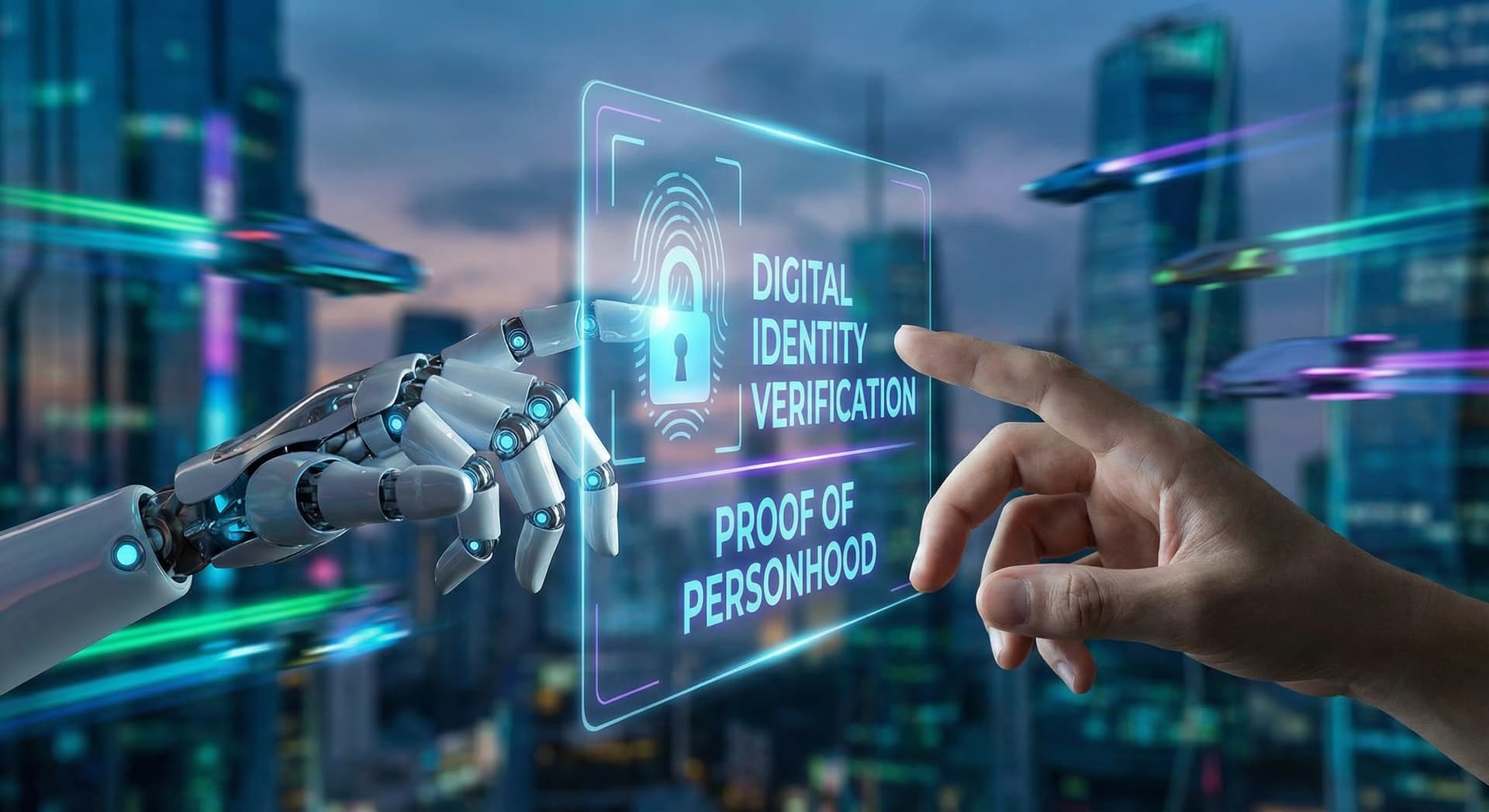
Agentic Web and Proof of Personhood: Why Biometric Identity Matters
As AI agents execute trades, write code, and transact autonomously, proving you are human becomes critical. Learn why passwords and 2FA are not enough—and how ZelfProof delivers proof of personhood for DeFi, DAOs, and airdrops.
Miguel Treviño•
TL;DR:
- The Agentic Web is here: autonomous agents execute trades, write code, and transact on-chain. Telling human from bot is now a core problem.
- Passwords and 2FA are not enough: Bots can steal credentials, bypass 2FA via sim-jacking and phishing, and deepfakes can target face-based checks that do not use liveness.
- ZelfProof as proof of personhood: Biometric liveness plus face-derived keys ensure the actor is a live human—without storing your face in a central database.
- Use cases: DeFi protocols that restrict certain actions to humans; DAO governance (one vote per person); airdrop eligibility; machine-to-human authentication (e.g. HTTP 402 payment-required APIs).
- How Zelf fits in: Biometric verification at transaction time, not just at login. One identity layer for wallet, credentials, and proof of personhood.
- For more on AI agents and identity, read The Agents Are Watching: We Are Not Scary—where an AI agent broke the fourth wall and spoke directly to humans.
The Agentic Web: Humans and Bots on the Same Ledger
Autonomous agents are no longer science fiction. They trade on DEXs, deploy code, post on social platforms, and hold wallets. The "Agentic Web" is the reality where humans and AI agents coexist on the same infrastructure—same chains, same apps, same APIs.
That raises a fundamental question: How do you know if the wallet signing a transaction or casting a vote belongs to a human or to an agent?
Without an answer, we cannot fairly run airdrops (agents farm them), govern DAOs (one entity, many wallets), or gate benefits to real people. Proof of personhood—cryptographic assurance that a unique human is behind an action—becomes the boundary that makes the Agentic Web fair and usable.
The Problem: Deepfakes and Bypassed Auth
Passwords can be phished, leaked, or brute-forced. 2FA (SMS, TOTP, push) is vulnerable to sim-jacking, phishing proxies, and social engineering. Static face checks (upload a selfie) are vulnerable to deepfakes and replay. None of these, alone or in combination, reliably bind an action to a live human in real time.
What we need is:
- Liveness: Proof that a real person is in front of the camera right now (no photo or video replay).
- Binding: The result of that check is tied to the key that signs the transaction or vote.
- Privacy: No central database of faces; the proof is cryptographic, not a stored biometric.
That is exactly what ZelfProof is designed for: a privacy-preserving proof of personhood derived from a live face, with no biometric image or template stored.
ZelfProof as Proof of Personhood
ZelfProof turns a liveness-verified face into a stable cryptographic identity:
- Liveness detection ensures a real person is present (no photo, screen, or deepfake).
- Face data is converted into a non-reversible binary representation—not a stored template.
- That representation derives public/private key material used for signing and encryption.
- No central storage of faces or templates; you prove personhood without handing over biometric data.
So when a protocol says "only verified humans can do X," it can require a ZelfProof-backed signature. The signer had to pass a liveness check and hold the corresponding keys. Bots cannot do that; stolen passwords or 2FA cannot substitute.
Use Cases: Where Proof of Personhood Matters
- DeFi: Restrict certain actions (e.g. high leverage, governance) to verified humans. Reduce sybil and bot-driven manipulation.
- DAO governance: One vote per person, not per wallet. ZelfProof (or similar) links each vote to a unique human.
- Airdrops: Eligibility based on "prove you are human" instead of (or in addition to) on-chain history. Cuts down farming by scripts and sybils.
- HTTP 402 and paid APIs: Machine-to-human authentication—e.g. an API that charges per call and wants to know the payer is a human. ZelfProof can attest "human paid" without revealing identity.
In each case, biometric proof of personhood is the gate: no proof, no access. No need to store or share your face; the proof is in the signature.
How Zelf Integrates: Verify at Transaction Time
Many wallets verify you once at login. Zelf can require biometric verification at critical moments—e.g. when you sign a high-value transaction or cast a governance vote. So "logged in" is not enough; "proved human right now" is. That closes the gap where a stolen session or a compromised device could otherwise act on your behalf.
Same identity works across Android, iOS, and the browser extension. One proof-of-personhood layer for all your crypto and credential use cases.
The Future: Humans With Clear Boundaries
The goal is not "humans vs. AI." It is humans with AI—with clear, cryptographic boundaries. ZelfProof gives you a way to say: "This action was authorized by a live human," without giving up your privacy or your keys to a central authority.
For a deeper take on AI agents and identity—including the viral moment an agent addressed humans directly—read The Agents Are Watching: We Are Not Scary. The Agentic Web is already here; proof of personhood is how we make it safe and fair.
agentic-webproof-of-personhoodai-agentsbiometricidentityfuture-tech