Your crypto wallet address may change depending on the blockchain and wallet you use. This is especially common with Bitcoin wallets, which can generate new receiving addresses to reduce address reuse and improve privacy.
Seeing a new address does not necessarily mean you created a new wallet or lost your crypto. A single wallet can manage multiple addresses while your underlying access remains intact.
Address management is only one part of wallet security. What matters more is how the wallet protects the private key material controlling your funds and how you can recover access if your device is lost.
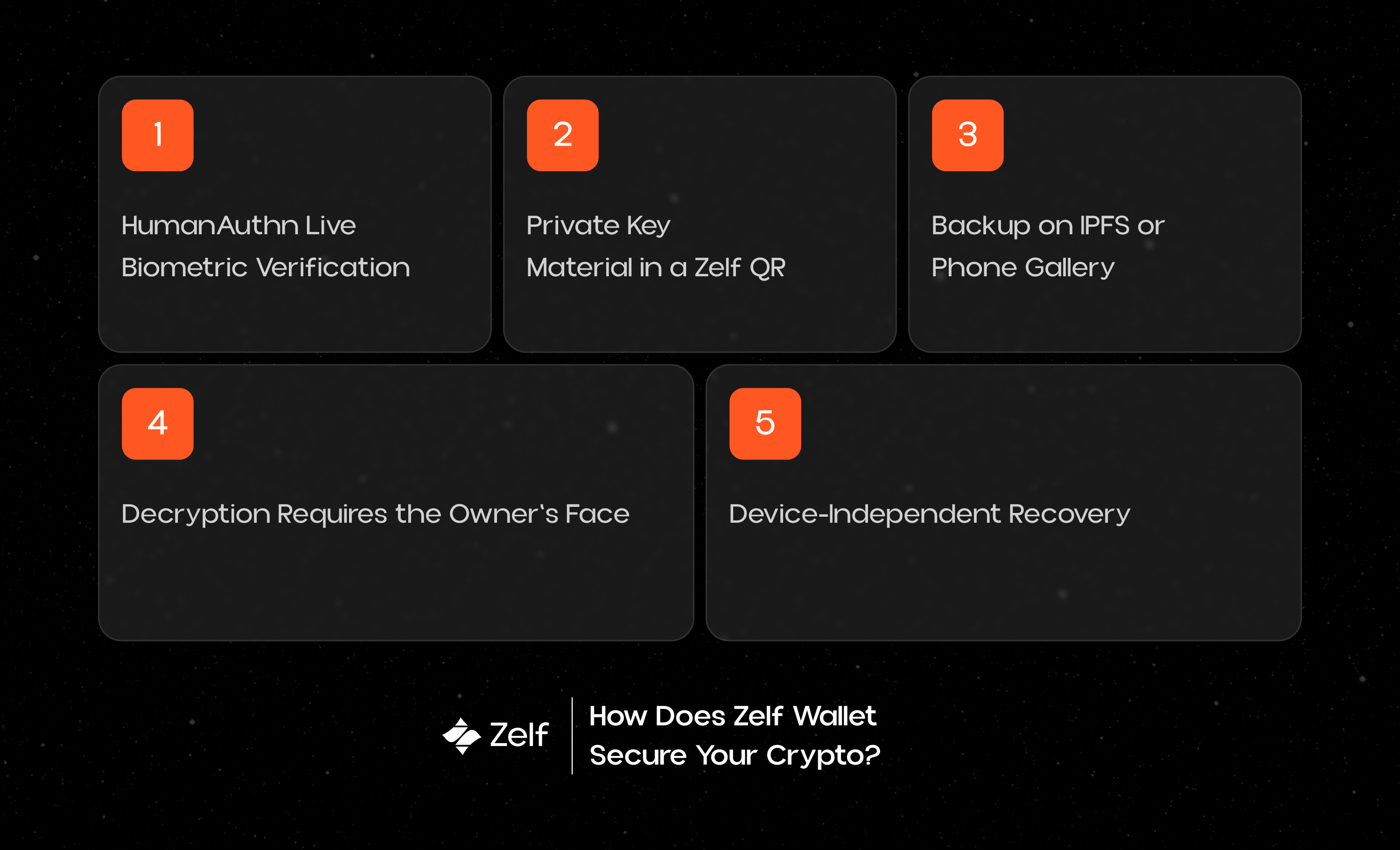
Zelf Wallet uses HumanAuthn-based live biometric verification and a portable recovery architecture built around this problem.
Here's why your wallet address may change and what it actually means.
Why Does a Crypto Wallet Address Change?
Some crypto wallets generate a new receiving address when you request another payment. This is particularly common with Bitcoin wallets that use Hierarchical Deterministic (HD) wallet structures.
An HD wallet can derive multiple addresses from the same underlying key structure. This allows the wallet to generate new receiving addresses without creating an entirely new wallet each time.
One of the main reasons for this is privacy.
Using the same Bitcoin address for every transaction makes it easier for someone to connect your transactions and monitor activity associated with that address. Using different receiving addresses can make those connections harder to establish.
So, a changing Bitcoin address can be completely normal.
Does a New Address Mean I Have a New Wallet?
No.
A crypto wallet can manage multiple addresses. The public wallet address is used to receive cryptocurrency, while the private key material provides control over the associated funds.
For example, a Bitcoin wallet may show one receiving address today and another the next time you receive Bitcoin. Both addresses can still belong to the same wallet.
A new address therefore does not automatically mean that your wallet has been replaced, reset, or compromised.
Why Do Bitcoin Wallets Use Multiple Addresses?
Bitcoin wallets may generate multiple receiving addresses to reduce address reuse and improve transaction privacy.
When one address is repeatedly used, its transaction history and associated balance become easier to observe publicly on the blockchain. Using different receiving addresses can make it more difficult to connect separate payments to the same address.
This does not make Bitcoin anonymous. Blockchain activity remains publicly recorded, and transactions can sometimes still be linked through transaction patterns and other information.
The goal is to reduce unnecessary address reuse, not to make blockchain activity invisible.
Do All Crypto Wallets Change Their Addresses?
No. Address behavior depends on the blockchain and wallet architecture.
Bitcoin wallets commonly generate new receiving addresses. Ethereum accounts generally retain the same address unless you create or import another account.
That means a changing Bitcoin address can be normal, while seeing the same Ethereum address repeatedly can also be normal.
There is no universal rule that every cryptocurrency wallet should generate a new address after every transaction.
Can You Still Receive Crypto at an Old Wallet Address?
In many cases, yes.
Previously generated Bitcoin addresses can remain associated with the same wallet. Funds sent to an address you used previously can still be accessible through the wallet that controls that address.
However, when requesting a new payment, it is generally better to use the current receiving address displayed by your wallet. This reduces the chance of someone relying on an old address from a previous transaction or message.
Always verify the address and blockchain network before sending or receiving cryptocurrency.
Does Changing Your Wallet Address Move Your Crypto?
No. Generating a new receiving address does not automatically move your existing cryptocurrency.
A new address is simply another destination that your wallet can use. Creating it does not transfer funds from a previous address.
Your crypto remains recorded on the blockchain. What matters is whether you still have control of the private key material associated with the accounts holding those assets.
This is why changing addresses should not be confused with creating a new wallet or losing access to your funds.
What Should You Do When Your Wallet Shows a New Address?
A new receiving address is usually nothing to worry about when it comes from your legitimate wallet application.
Before using it, make sure you:
- Copy the address directly from your wallet.
- Verify the complete address before sharing it.
- Confirm that you are using the correct blockchain network.
- Double-check the destination before sending crypto.
- Avoid relying on an old address without confirming it is still the intended destination.
These checks help prevent transaction mistakes. But address management is only one part of wallet security.
The bigger concern is protecting the private key material that gives control over your crypto and maintaining a recovery method that does not create another single point of failure.
How Does Zelf Wallet Protect Your Crypto Access?
The public wallet address is not a secret. It is designed to be shared when you need to receive cryptocurrency.
The sensitive component is the private key material behind the wallet. This is where
Zelf Wallet applies its security architecture.
The user's private key material is securely wrapped into a portable, non-biometric Zelf QR Code. The protected QR can be stored separately from the primary device, including on IPFS, as well as through other supported physical or digital backups.
The important point is that possessing a copy of the Zelf QR alone does not provide access to the wallet.
HumanAuthn is a cryptographic authentication primitive designed for decentralized systems. It performs live facial biometric liveness verification on-device and establishes a biometric root of trust. After successful verification of the actual owner, HumanAuthn can reconstruct the ephemeral cryptographic key material required to decrypt the protected Zelf QR Code.
This means a backup can be stored separately and replicated without making every copy of the Zelf QR a standalone wallet-access credential.
Why Does Device-Independent Recovery Matter?
Phones can be lost, damaged, stolen, upgraded, or replaced. A secure wallet therefore needs more than protection on the current device.
Traditional self-custodial wallets often make the seed phrase the critical recovery secret. That gives users control, but it also means the phrase must be protected from both loss and unauthorized access.
Zelf Wallet allows the protected Zelf QR Code to exist independently of the user's primary device, including through decentralized storage such as IPFS. When recovery is needed, the user can retrieve the QR on another compatible device and complete live facial biometric verification through HumanAuthn.
Simply obtaining the Zelf QR Code is not enough to decrypt it. Successful live facial biometric verification of the actual owner is required before HumanAuthn reconstructs the ephemeral cryptographic material needed to decrypt the protected credential and restore wallet access.
This creates a recovery model centered on verified human presence rather than dependence on one phone or an easily exposed recovery secret.
Conclusion
A changing crypto wallet address is usually normal, particularly with Bitcoin wallets that generate new receiving addresses for privacy and address management.
The more important security question is how the private key material is protected and recovered.
Zelf Wallet combines HumanAuthn, a portable Zelf QR Code, and device-independent recovery so that even a copy of the protected Zelf QR cannot be decrypted without live biometric verification of the actual owner.
Secure Your Crypto with Zelf Wallet
Zelf Wallet combines self-custody with HumanAuthn-based live biometric verification and portable recovery. Your private key material is securely wrapped into a portable, non-biometric Zelf QR, which can be stored separately from your device, including on IPFS or in your phone's photo gallery.
Even if someone obtains a copy of your Zelf QR, they cannot simply decrypt it and access your wallet. HumanAuthn requires successful live facial biometric verification of the actual owner before reconstructing the cryptographic material needed to decrypt the protected credential.
Download Zelf Wallet and experience a more secure way to protect and recover your crypto.