Sending cryptocurrency to the wrong wallet address can be a serious mistake because most blockchain transactions cannot simply be reversed. Once a transaction is confirmed, the network generally does not provide a built-in way to cancel it.
What happens next depends on where the crypto was sent. You may be able to recover it if you sent it to an address you control or an exchange that can assist you. If the address belongs to someone else and they do not return the funds, recovery may not be possible.
This is why verifying a wallet address before sending is one of the most important habits in crypto.
Zelf Wallet also addresses part of this risk by offering features designed to reduce reliance on manually handling long wallet addresses.
What Happens When You Send Crypto to the Wrong Address?
When you send cryptocurrency, you are authorizing a blockchain transaction to transfer funds to a specific destination address.
Once the transaction is confirmed, the blockchain records that transfer. Unlike a traditional bank transfer, there is usually no central authority that can simply reverse the transaction because you entered the wrong address.
Your recovery options therefore depend on who controls the destination.
If the address belongs to you, you may still be able to access the funds through the wallet that controls it. If it belongs to another person, you generally need that person to send the cryptocurrency back.
If the address is not controlled by anyone who can access the funds, recovery may be impossible.
Can a Crypto Transaction to the Wrong Address Be Reversed?
Usually, no.
Blockchains are designed to validate and record transactions without a central party that can arbitrarily undo them. Once a transaction is confirmed, changing the recipient normally requires a new transaction from whoever controls the destination address.
There can be exceptions involving centralized exchanges or custodial services. If you accidentally send funds to an exchange-controlled address, the exchange may have procedures for attempting recovery, although recovery is not guaranteed.
The sooner you identify the mistake, the sooner you should contact the relevant service or wallet owner.
What If I Sent Crypto to the Wrong Address but the Transaction Is Pending?
A pending transaction may give you a small window to explore whether your wallet or network supports cancellation or replacement, but this depends heavily on the blockchain and transaction mechanism.
Do not assume that every pending transaction can be stopped.
For some networks, transaction replacement or cancellation may be possible under specific conditions. For others, the transaction may simply proceed once it is accepted and confirmed.
The safest response is to check the wallet and network documentation immediately rather than waiting for confirmation.
What If I Sent Crypto to an Address I Control?
This is usually much less serious.
You may have accidentally sent crypto to another address belonging to your own wallet, another wallet you control, or another account you can still access.
In that case, the funds are not necessarily lost. The important step is determining which wallet or account controls the destination address.
This is another reason to understand the difference between an address and a wallet. One wallet can manage multiple addresses, particularly with Bitcoin.
What If I Sent Crypto to an Exchange by Mistake?
If the destination address belongs to a centralized exchange, contact the exchange as soon as possible.
Provide the transaction hash, asset, network, destination address, amount, and any other information the exchange requests. Some platforms may be able to recover assets in certain circumstances, but the outcome depends on the platform and the specific transaction.
Never assume that an exchange can reverse every mistaken transfer.
What If I Sent Crypto on the Wrong Network?
Sending an asset using an incompatible network can create a different recovery problem.
For example, an exchange or wallet may support a token on one network but not another. The funds may not appear in the expected account even though the transaction was successfully recorded on-chain.
Recovery can sometimes be possible when the destination platform controls the address and supports the relevant network, but this depends on the asset, network, wallet, and service involved.
Always check the network before confirming a transaction.
How Can You Verify a Wallet Address Before Sending?
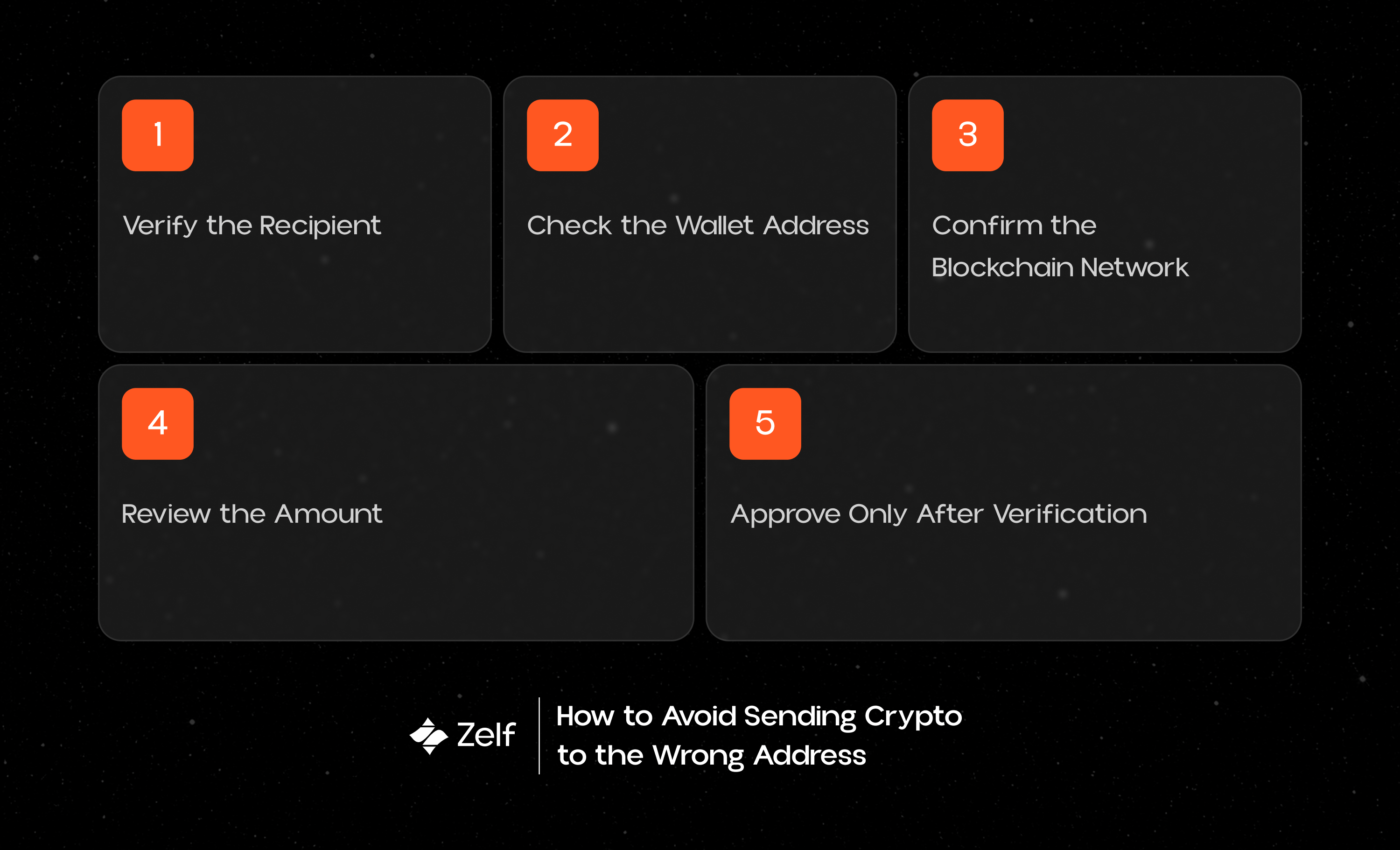
Because blockchain transactions are often irreversible, verification should happen before you approve the transaction.
Start by checking the address from the original source rather than trusting a copied address from an unexpected message. Compare the destination carefully, confirm the blockchain network, and make sure the asset you are sending is supported on that network.
For larger transfers, sending a small test amount first can provide an additional layer of confidence.
You should also be cautious with addresses displayed through untrusted websites, messages, browser extensions, or other software that could potentially manipulate what you see.
How Can Zelf Wallet Help Reduce Address Errors?
Manually copying and pasting long wallet addresses creates an obvious opportunity for human error and address-replacement attacks.
Zelf Wallet includes a Send-to-Name experience in which users can enter the recipient’s Zelf ID instead of manually copying a long public wallet address. The associated address can then be presented automatically, reducing the need to handle lengthy hexadecimal strings and helping reduce certain phishing and man-in-the-middle risks.
This does not eliminate the need to verify a transaction before signing. It simply reduces one common source of mistakes during the recipient-selection process.
Conclusion
Sending crypto to the wrong address can be difficult or impossible to undo once the transaction is confirmed. Your best protection is careful verification before you approve a transfer.
Zelf Wallet helps reduce some of the risks around manual address handling through Send-to-Name and strengthens transaction authorization with HumanAuthn-based live biometric verification.
Reduce Crypto Sending Risks with Zelf Wallet
Mistyped or manipulated addresses can turn a simple crypto transfer into a costly mistake.
Zelf Wallet makes recipient selection simpler through human-readable Zelf IDs while adding HumanAuthn-based biometric authentication to the wallet experience.
Download Zelf Wallet and make your crypto transfers simpler and more secure.