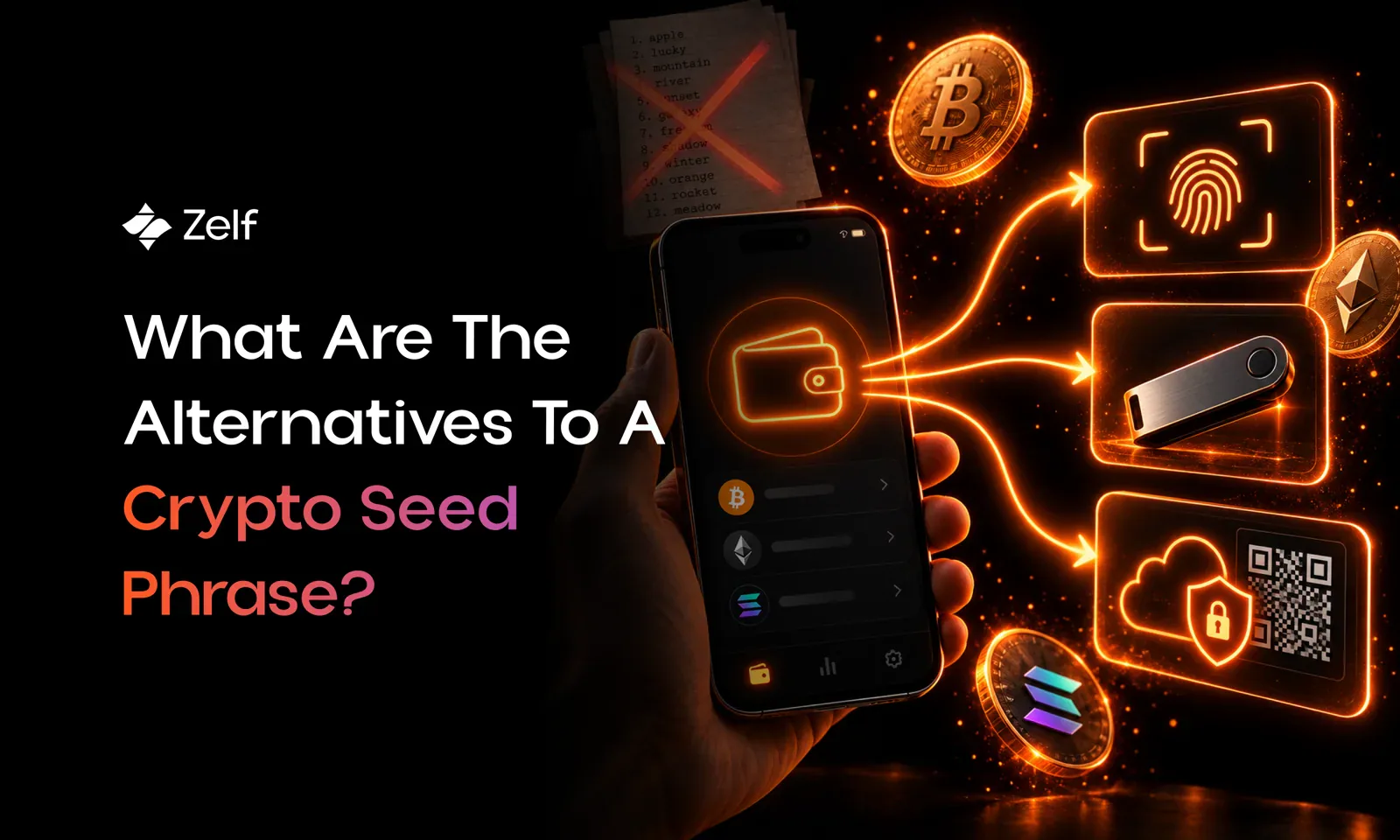
A seed phrase is the traditional recovery method used by many self-custodial crypto wallets, but it is not the only option. Newer wallet architectures are exploring alternatives such as passkeys, social recovery, and biometric authentication.
Each model changes how wallet access is recovered, but the security tradeoffs are different. Some still depend on devices, trusted people, or other external systems.
Zelf Secur uses a different security model built around HumanAuthn and a biometric root of trust. Instead of making a traditional seed phrase the central recovery secret, private key material is protected through an encrypted, portable Zelf QR that requires live biometric verification of the actual owner for decryption.
Why Look for an Alternative to a Seed Phrase?
Seed phrases provide a straightforward way to restore a self-custodial wallet, but they place significant responsibility on the user.
A seed phrase must be kept private, protected from theft, stored safely, and remain available when recovery is needed. If it is lost, damaged, or exposed, the consequences can be severe.
The security problem is not that seed phrases do not work. They do. The issue is that one static secret becomes extremely important to both wallet recovery and security.
That is why newer wallet designs are exploring different recovery models.
What Are the Main Alternatives to a Crypto Seed Phrase?
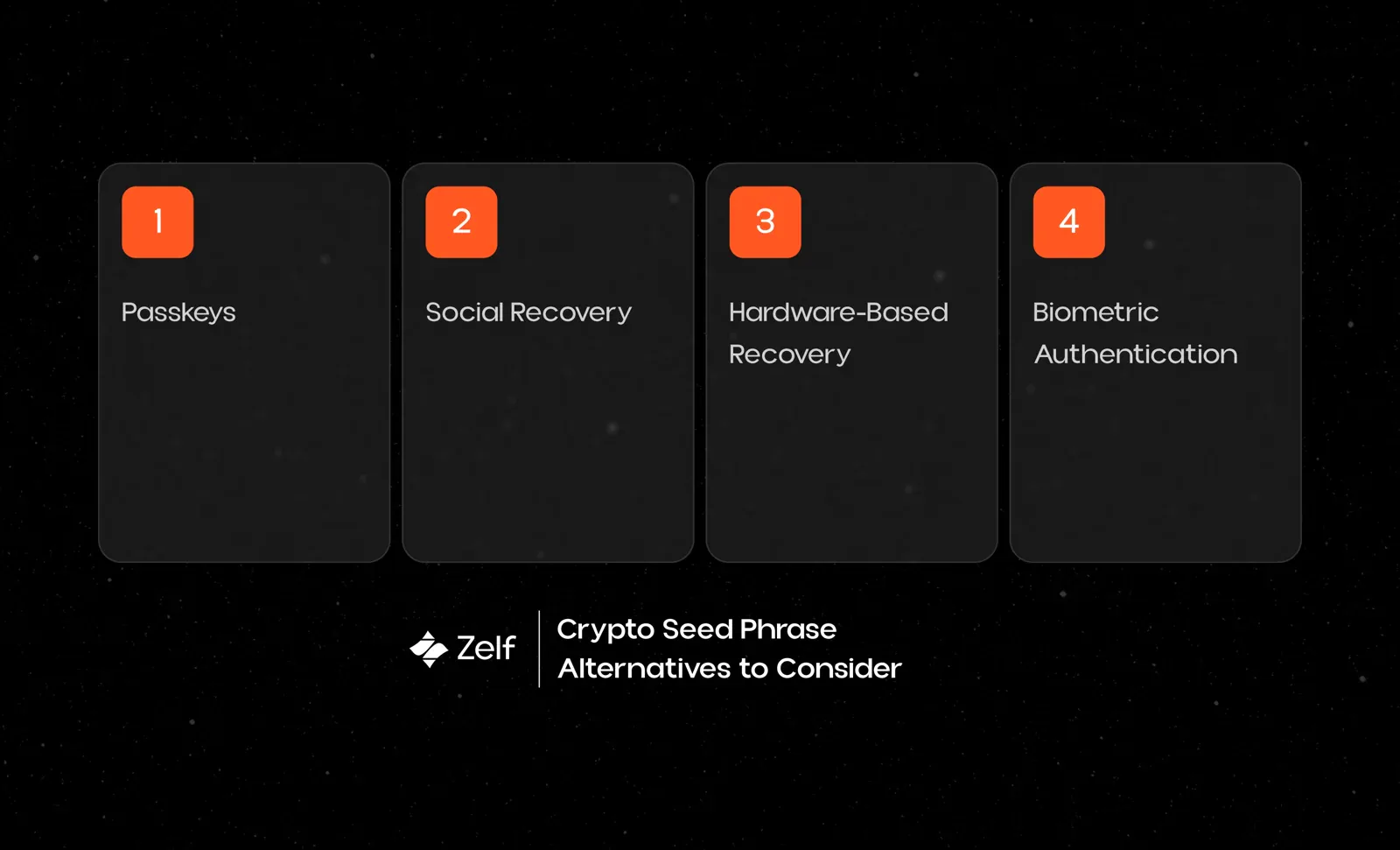
There is no single replacement used by every wallet. Common alternatives include:
Passkeys
Passkeys use modern device-based authentication, often backed by biometrics such as a fingerprint or face unlock.
They can make authentication easier than entering a long recovery phrase, but the exact recovery experience depends on how the wallet implements passkey support.
Social Recovery
Social recovery allows trusted people, devices, or designated guardians to help restore access under specific conditions.
This reduces reliance on one recovery phrase, but it introduces another consideration: the security of the recovery participants and the recovery rules themselves.
Hardware-Based Recovery
Hardware wallets protect private keys using dedicated devices. However, many hardware wallets still rely on a recovery phrase if the physical device is lost or replaced.
The hardware device and the recovery phrase therefore solve different problems.
Biometric Authentication
Some newer wallet architectures, such as
Zelf Secur, use biometric authentication as part of the wallet access or recovery process.
The important distinction is whether biometrics are simply used to unlock a device or are part of the wallet's cryptographic authentication architecture.
This is where HumanAuthn is designed to go further.
How Does Zelf Secur Replace Traditional Seed Phrase Dependence?
Zelf Secur uses
HumanAuthn, a cryptographic authentication primitive that establishes a
biometric root of trust.
During enrollment, a live biometric signal is combined with previously generated high-entropy random material to derive ephemeral cryptographic key material. This material is used to protect the user's private key material inside a privacy-preserving, encrypted Zelf QR.
The Zelf QR is non-biometric. It does not contain raw biometric data or usable private keys in plaintext.
This is important because the backup itself does not become the sole authentication secret.
What Happens If Someone Gets Your Zelf QR?
The Zelf QR can be stored separately from the user's primary device, including on IPFS, as a physical backup, or in a phone's photo gallery. It can also be replicated because it does not expose usable private keys in plaintext.
But obtaining the QR is not enough to access the wallet.
Zelf Secur requires successful live facial biometric liveness verification through HumanAuthn. The biometric signal and previously generated entropy are used to reconstruct the ephemeral cryptographic key material required to decrypt the protected credential. If the required biometric verification does not succeed, that decryption process cannot be completed.
This is one of the most important differences between a static recovery secret and a recovery system based on Proof of Humanity.
How Does Biometric Recovery Work on a New Device?
A seed phrase-based wallet generally requires the user to enter the recovery phrase on the new device.
With
Zelf Secur, the protected Zelf QR can be retrieved from its separate storage location and used on another compatible device. The user then completes live biometric liveness verification through HumanAuthn.
After successful verification, the required ephemeral cryptographic key material is reconstructed to decrypt the protected credential and restore wallet access.
The recovery credential therefore does not have to remain on the original phone. This makes the wallet device independent while keeping access tied to verified human presence.
Is a Seed Phrase Still Needed With Every Seedless Wallet?
No. The recovery mechanism depends on the wallet's architecture.
Some wallets may use passkeys, social recovery, or other cryptographic methods. Others may still use a seed phrase somewhere in the underlying system even if the user does not interact with it in the same way.
This distinction matters when comparing "seedless" wallets. Not having to write down 12 or 24 words does not automatically tell you how the wallet actually protects or recovers private key material.
A secure design should make the recovery mechanism clear and explain what happens if a device, backup, or authentication factor is lost.
Why Is Zelf Secur's Approach Different?
Zelf Secur combines several layers rather than simply replacing words with another login method.
Its architecture uses HumanAuthn as a biometric root of trust, while the user's private key material is securely wrapped into a portable, non-biometric Zelf QR. The credential can be stored independently, including through decentralized storage such as IPFS.
Most importantly, the stored QR is not itself enough to decrypt the wallet. Access requires live biometric verification of the actual owner through HumanAuthn, which reconstructs the ephemeral cryptographic material needed for decryption.
This shifts the recovery model away from relying on possession of a single static secret and toward authenticated human presence.
Which Seed Phrase Alternative Is Best?
There is no universal answer because each alternative has a different security model.
Passkeys can simplify authentication. Social recovery can distribute recovery responsibility. Hardware wallets can isolate private keys from general-purpose devices. Biometric wallet architectures can tie authentication to the user.
For users looking for self-custody without making a traditional seed phrase the central recovery mechanism,
Zelf Secur offers a strong combination of biometric authentication, protected private key material, portable recovery, and Proof of Humanity.
The key question is not simply whether a wallet is "seedless." It is how securely the wallet protects the underlying private key material and how recovery works when something goes wrong.
Conclusion
Seed phrases are not the only way to recover a crypto wallet. Passkeys, social recovery, hardware-based approaches, and biometric authentication all offer different alternatives.
Zelf Secur stands out by combining self-custody with HumanAuthn, Proof of Humanity, and a protected Zelf QR that can be stored separately while requiring live verification of the actual owner for decryption.
Move Beyond Traditional Seed Phrases with Zelf Secur
Seed phrases put a great deal of responsibility on one static secret.
Zelf Secur combines self-custody with HumanAuthn-based live biometric authentication and a portable Zelf QR recovery model.
Your protected credential can be stored separately, including on IPFS or in your phone's gallery, while access remains tied to successful verification of the actual owner.
Download Zelf Secur and experience a smarter approach to crypto security and recovery.