For years, seed phrases have been the standard way to recover a self-custodial crypto wallet. They give users control, but they also create a major security responsibility: protecting a single secret that can restore the wallet.
Seedless wallets are designed to reduce that burden by using alternative methods for authentication and recovery. But seedless does not automatically mean safer. The real question is how the wallet protects private key material, verifies the user, and handles recovery.
For most users, a
well-designed seedless wallet can offer a more practical security model than a traditional seed phrase wallet, especially when it preserves self-custody while reducing exposure to a single recovery secret.
What Is a Seed Phrase Wallet?
A seed phrase wallet uses a sequence of recovery words that can be used to recreate a wallet and its associated private keys.
The main advantage is straightforward: you control the recovery method instead of depending on a centralized provider. If your device is lost, you can normally restore the wallet on another compatible device using the seed phrase.
The problem is that the seed phrase becomes a high-value secret. Anyone who obtains it may be able to recreate the wallet and control its assets. Losing it can also make recovery impossible if no other valid backup exists.
This creates a simple tradeoff:
More direct control means more responsibility for protecting the recovery secret.
What Is a Seedless Wallet?
A
seedless wallet removes the need for the user to manage a traditional seed phrase as the primary recovery mechanism.
Instead, it may use methods such as passkeys, social recovery, hardware-based authentication, or
biometrics. The important point is that the term "seedless" describes the user-facing recovery model, not the absence of cryptographic keys.
A
self-custodial seedless wallet still needs cryptographic key material to authorize transactions. What changes is how that material is protected and how the legitimate user gains access to it.
That distinction is important when comparing security. A wallet should not be considered safer simply because it does not show you a 12- or 24-word phrase.
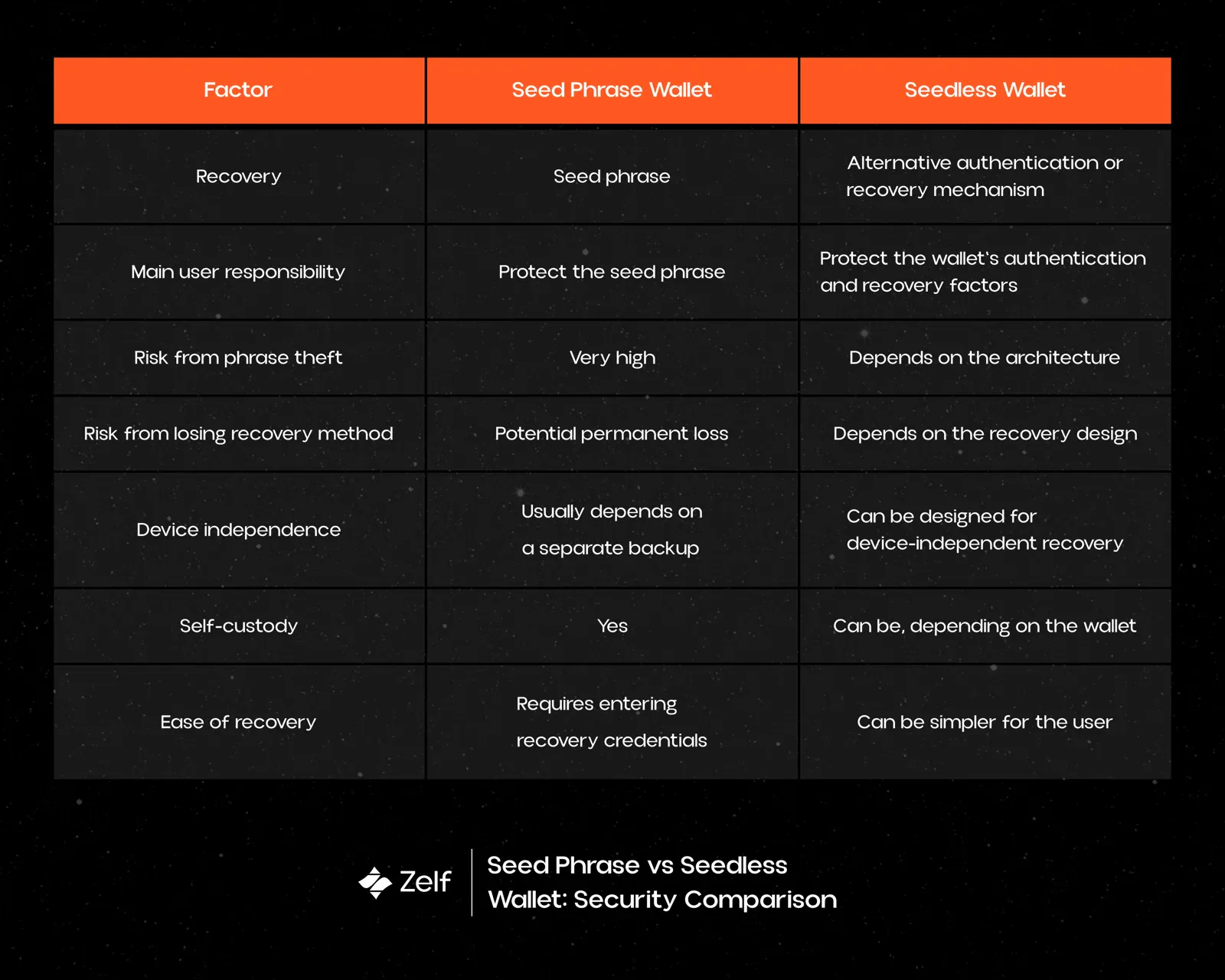
Seed Phrase vs Seedless Wallet: Security Comparison
| Factor | Seed Phrase Wallet | Seedless Wallet |
|---|
| Recovery | Seed phrase | Alternative authentication or recovery mechanism |
| Main user responsibility | Protect the seed phrase | Protect the wallet's authentication and recovery factors |
| Risk from phrase theft | Very high | Depends on the architecture |
| Risk from losing recovery method | Potential permanent loss | Depends on the recovery design |
| Device independence | Usually depends on a separate backup | Can be designed for device-independent recovery |
| Self-custody | Yes | Can be, depending on the wallet |
| Ease of recovery | Requires entering recovery credentials | Can be simpler for the user |
The table shows why the comparison is not simply "old versus new." Security depends on what replaces the seed phrase and whether the replacement avoids creating another single point of failure.
Which Is Safer: Seed Phrase or Seedless?
For a carefully designed self-custodial wallet, seedless can be safer for many users because it removes the need to protect one static recovery secret.
A traditional seed phrase can be photographed, copied, written incorrectly, stored insecurely, lost, or exposed through phishing and social engineering. Once exposed, an attacker may be able to recover the wallet independently of the legitimate owner.
Seedless wallets can reduce this risk, but only when the underlying architecture is strong.
A seedless wallet that depends entirely on a centralized account, email access, or a third party simply moves the point of trust somewhere else. That may improve usability without necessarily delivering stronger self-custody.
The stronger model is one that combines convenient authentication with decentralized recovery and keeps the user in control.
How Zelf Uses a Seedless Recovery Model
Zelf Securuses HumanAuthn and an encrypted Zelf QR Code instead of making a traditional seed phrase the center of wallet recovery.
HumanAuthn is a cryptographic authentication primitive that establishes a biometric root of trust. During enrollment, live biometric liveness verification is combined with high-entropy random material to derive cryptographic key material. That material is used to protect the user's private keys inside an encrypted credential.
The result is a Zelf QR that can be stored separately from the device. Because the credential is encrypted and does not expose usable private keys in plaintext, it can be kept in places such as IPFS, a physical backup, or a phone's photo gallery.
When recovery is required, the user retrieves the encrypted credential and completes live biometric verification through HumanAuthn. A successful verification allows the required ephemeral cryptographic key material to be reconstructed and used to decrypt the credential.
This makes recovery device independent rather than tying access permanently to one phone.
Does Seedless Mean There Are No Private Keys?
No.
This is one of the most important misconceptions about seedless wallets.
A seedless wallet still uses cryptographic key material because blockchain transactions require cryptographic authorization. The difference is that the user does not have to manage that key material through a traditional seed phrase.
With
Zelf Secur, private key material is encapsulated within an encrypted Zelf QR rather than exposed to the user as a plaintext recovery phrase. HumanAuthn provides the authentication mechanism required to access it.
So the better way to think about seedless is:
No seed phrase does not mean no cryptography. It means a different way of protecting and recovering the cryptographic credentials.
What Happens If Someone Gets Your Zelf QR?
Obtaining a copy of the encrypted Zelf QR does not by itself give someone the plaintext private keys.
The credential is designed to contain protected key material rather than usable private keys in plaintext, and successful live biometric verification through HumanAuthn is required to reconstruct the ephemeral cryptographic material needed for decryption.
This is also why the recovery credential can be stored separately and replicated. Its security does not depend on keeping the QR itself completely hidden in the same way a traditional seed phrase must be kept secret.
Is Seedless Better for Self-Custody?
It can be, provided the wallet remains genuinely self-custodial.
The strongest seedless designs aim to reduce the operational problems of seed phrases without replacing self-custody with dependence on a centralized provider.
Zelf Secur combines HumanAuthn, decentralized storage of the encrypted credential, and device-independent recovery. The authentication model is based on live biometric verification and Proof of Humanity rather than a static recovery phrase or a device-specific trust anchor.
For users who find seed phrase management difficult, this can provide a more practical balance between security, recovery, and usability.
Seed Phrase vs Seedless Wallet: Which Should You Choose?
A seed phrase wallet remains a valid self-custody option when the recovery phrase is stored correctly and protected from unauthorized access.
A seedless wallet may be the better choice for users who want to avoid managing a static recovery secret, but its security should be evaluated based on its actual architecture rather than the word "seedless."
Look at three things: who controls the keys, how the user is authenticated, and how recovery works if the original device is lost.
That is ultimately what determines whether a wallet is secure.
Conclusion
Seed phrases offer proven self-custody, but they place significant responsibility on the user to protect one recovery secret. Seedless wallets can reduce that burden, but only when their authentication and recovery architecture is designed properly.
Zelf Secur combines biometric authentication, encrypted key protection, and device-independent recovery to provide a seedless approach while keeping self-custody at the center of the wallet design.
Protect Your Crypto Without a Seed Phrase
Managing a recovery phrase should not be the only way to secure self-custodial crypto.
Zelf Secur uses HumanAuthn, an encrypted Zelf QR, and a biometric root of trust to make authentication and recovery more closely tied to the legitimate user.
Download Zelf Secur and explore a seedless approach to self-custodial crypto security.