Yes, crypto wallets can work without making a traditional seed phrase the main recovery method. Instead, newer wallet architectures can use alternatives such as passkeys, social recovery, or biometric authentication.
The important question is what replaces the seed phrase and how the wallet protects the private key material behind your assets.
Zelf Secur uses HumanAuthn and a biometric root of trust to replace traditional seed phrase dependence with a protected recovery model built around live biometric verification.
Why Do Traditional Crypto Wallets Use Seed Phrases?
Traditional self-custodial wallets commonly use a seed phrase as a recovery mechanism.
A seed phrase is typically a sequence of 12 or 24 words that can be used to recreate the wallet's underlying cryptographic keys. Because possession of the phrase can provide access to the wallet, it has to be kept private and securely backed up.
This creates a significant responsibility for the user.
A seed phrase can be lost, damaged, forgotten, or exposed through phishing, malware, screenshots, cloud backups, or other insecure storage. Once exposed, anyone who obtains it may be able to recreate the wallet and control the associated assets.
What Replaces a Seed Phrase?
There is no single replacement used by every seedless wallet.
Different wallet architectures may use:
- Passkeys
- Social recovery
- Hardware-based recovery
- Biometric authentication
- Other cryptographic recovery mechanisms
The important distinction is that removing the seed phrase from the user experience does not automatically make a wallet secure.
You still need to understand where the private key material is protected, how the user is authenticated, and how wallet access can be recovered.
How Does a Wallet Work Without Showing You a Seed Phrase?
A seedless wallet can separate the process of wallet creation and recovery from the traditional 12- or 24-word backup.
Instead of asking the user to protect a static recovery phrase, the wallet can use another authentication mechanism to establish that the legitimate user is present.
With Zelf Secur, this is handled through
HumanAuthn, a cryptographic authentication primitive that establishes a biometric root of trust.
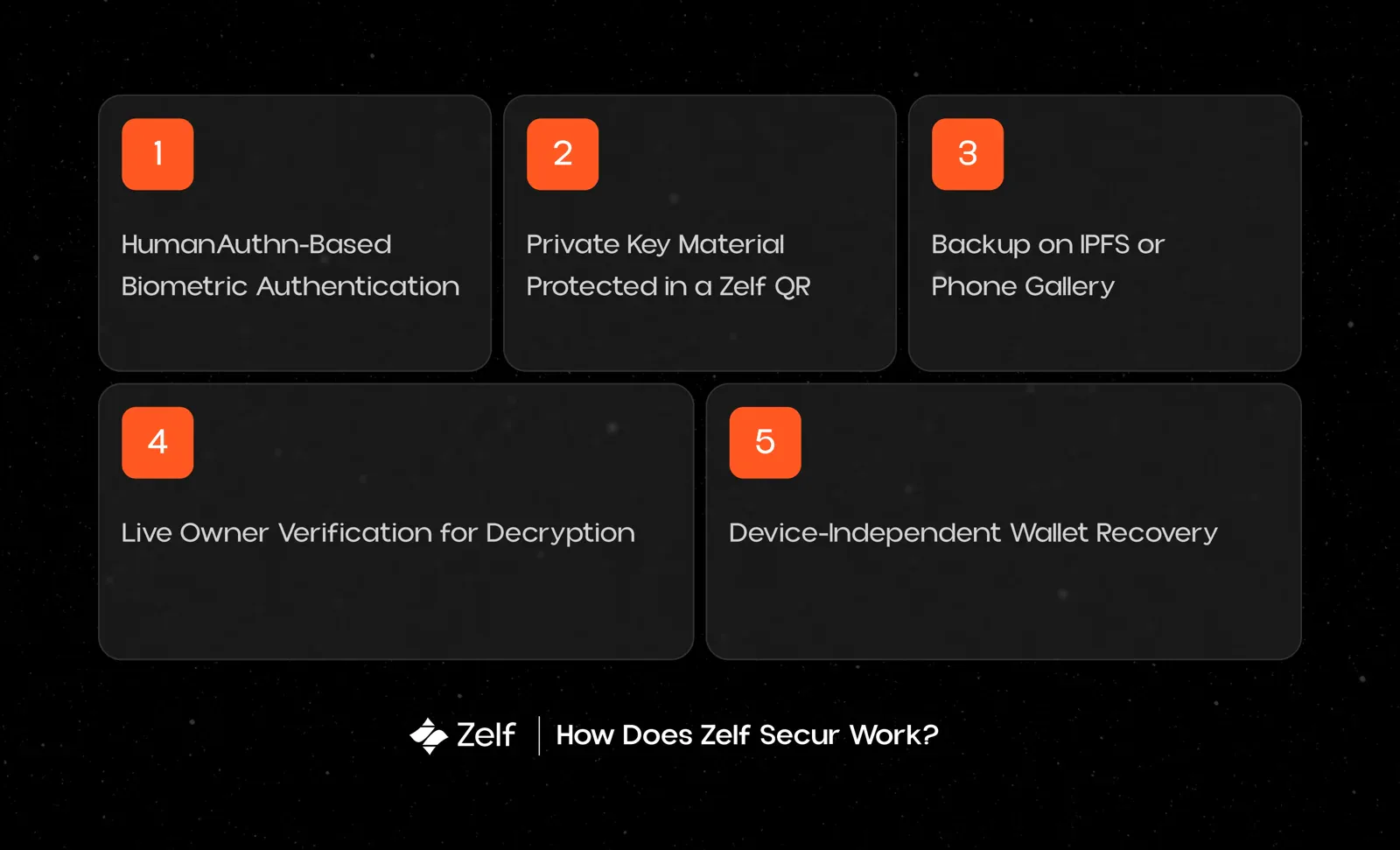
During enrollment, live biometric liveness verification is combined with high-entropy random material to derive ephemeral cryptographic key material. This cryptographic material is used to protect the user's private key material inside an encrypted, privacy-preserving credential.
What Is the Role of a Zelf QR?
The protected private key material in
Zelf Secur is securely wrapped into a portable, non-biometric
Zelf QR.
The Zelf QR is not a plain-text version of the user's private keys. It does not contain stored biometric templates, raw biometric data, or usable private keys in plaintext.
Because the credential remains encrypted, it can be stored separately from the device. Supported storage options include IPFS, physical backups, and the user's phone photo gallery. It can also be replicated without exposing usable private key material.
This is an important part of how a seedless recovery architecture works. The backup exists, but possession of the backup is not by itself enough to gain wallet access.
Can Someone Access Your Zelf Secur Wallet If They Find the Zelf QR?
No. The Zelf QR code alone is not sufficient to decrypt the protected credential.
When authentication is required, HumanAuthn captures a new live biometric input and combines it with the previously generated entropy. If biometric liveness and matching succeed, the system reconstructs the ephemeral cryptographic key material required to decrypt the protected credential.
If the required biometric verification does not succeed, the ephemeral key cannot be reconstructed and the protected credential cannot be decrypted.
This is a fundamental security property of the model: a copied backup is not equivalent to wallet access.
How Does Recovery Work Without a Seed Phrase?
With
Zelf Secur, recovery can take place on another compatible device rather than depending on the original phone.
The user retrieves the encrypted Zelf QR from its backup location and completes live facial biometric liveness verification through HumanAuthn. After successful verification, the required ephemeral cryptographic material is reconstructed to decrypt the protected credential and restore wallet access.
This makes the recovery model device independent.
The user is no longer relying on one particular phone to maintain access, while the recovery credential itself can remain stored separately.
Is a Seedless Wallet Really Self-Custodial?
It can be, depending on how the wallet is designed.
Self-custody means the user retains control of the cryptographic authorization for their assets rather than handing that control to a centralized custodian.
A wallet does not become custodial simply because it does not use a traditional seed phrase. The relevant question is whether a third party controls the private key material or can independently authorize transactions on the user's behalf.
Zelf Secur is designed to preserve self-custody while changing how authentication and recovery are handled. Its architecture shifts the trust anchor away from a specific device toward human presence through a biometric root of trust.
Why Is HumanAuthn Important?
HumanAuthn is not simply a facial recognition feature.
It is a cryptographic authentication primitive designed for decentralized systems. Its purpose is to establish a biometric root of trust that can be used to reconstruct the cryptographic material required for protected wallet access.
The biometric verification happens live and on-device. HumanAuthn does not rely on storing raw biometric data or biometric templates as long-lived authentication credentials.
This is what allows
Zelf Secur to use Proof of Humanity as part of its wallet security model rather than making possession of a static recovery phrase the central condition for recovery.
What Are the Benefits of a Seedless Recovery Model?
The biggest benefit is reducing dependence on a single static recovery secret.
A traditional seed phrase has to be protected from both loss and unauthorized access. A seedless design can distribute the security responsibility differently by separating the protected wallet credential from the authentication mechanism.
With
Zelf Secur, the encrypted Zelf QR can be stored independently, while HumanAuthn verifies the actual user before the credential can be decrypted.
This also supports device-independent recovery. Losing a phone does not necessarily mean losing the recovery credential, and finding the backup does not automatically give an attacker access to the wallet.
Can Zelf Secur Work Without an Internet Connection?
Zelf Secur also offers an offline version through its Free Forever Plan.
The documented offline flow allows users to download the app, switch it offline, search for a name, generate or import a seed phrase, scan their face, and generate a Zelf QR code. The generated QR must then be saved locally and stored safely.
This offline capability is particularly relevant when discussing wallet setup and local security, but it should not be interpreted as meaning that every wallet function is always available without connectivity.
Conclusion
Crypto wallets can work without making a traditional seed phrase the center of recovery.
Zelf Secur uses HumanAuthn and a biometric root of trust to protect private key material in a portable Zelf QR, while live biometric verification of the actual owner is required to decrypt the protected credential.
Move Beyond Seed Phrase Dependence with Zelf Secur
Traditional recovery puts a great deal of responsibility on a static secret.
Zelf Secur combines self-custody with HumanAuthn-based live biometric authentication and a portable Zelf QR recovery model.
Your protected credential can be stored separately, including on IPFS or in your phone's gallery, while access remains tied to successful verification of the actual owner.
Download Zelf Secur and experience a smarter approach to crypto security and recovery.