A strong password can protect access to your wallet. A hardware device can keep your private keys isolated. But what happens if the mathematical problems behind cryptographic security become practical to solve?
That is the question behind P vs. NP. As of November 28, 2026, it remains an open problem. A proof that P = NP would be a major mathematical discovery, but it would not automatically unlock every wallet. Practical consequences would depend on the algorithm and the resources needed to run it. [1, 2]
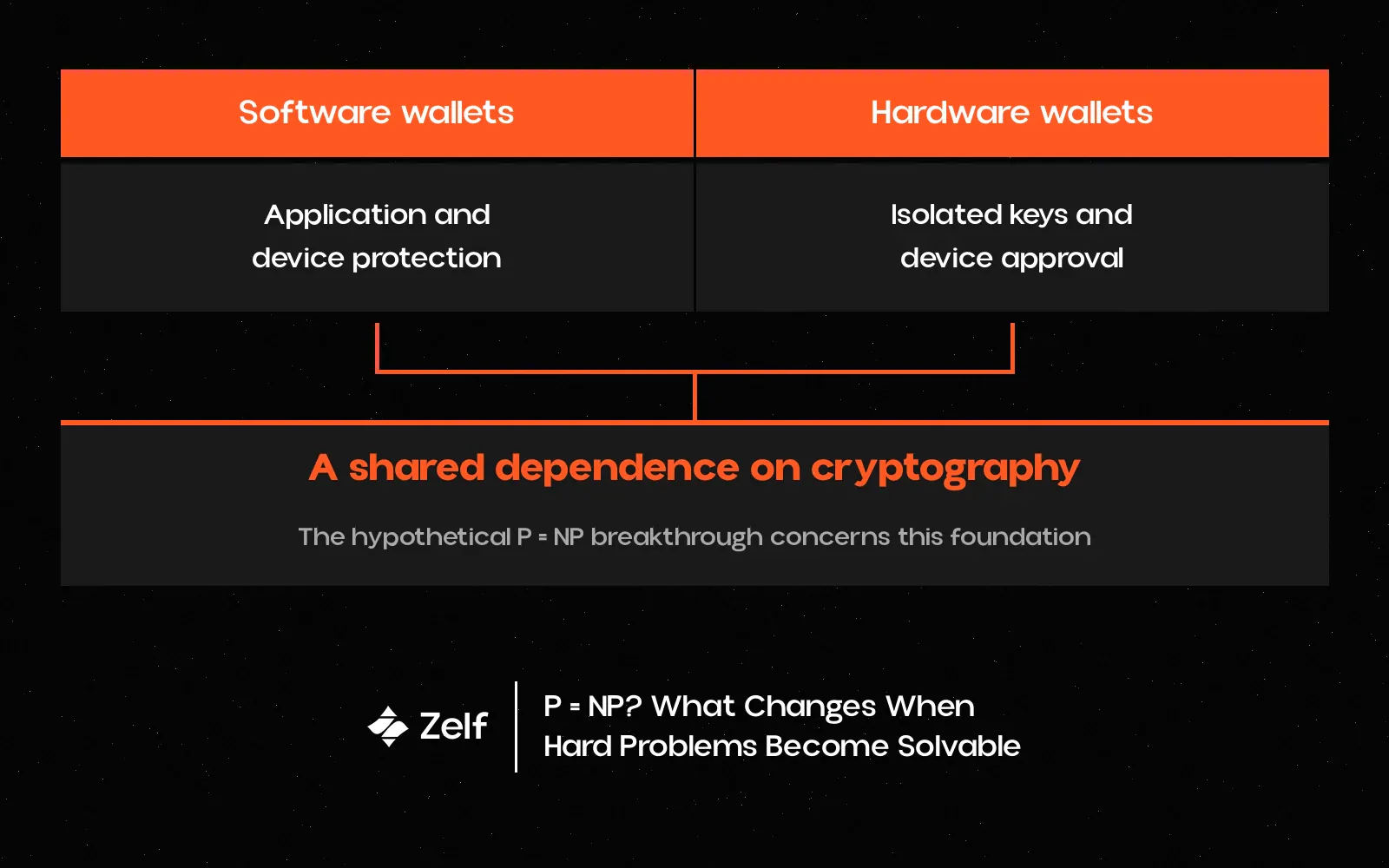
This article explores that hypothetical scenario for software wallets such as MetaMask and Phantom, hardware wallets such as Trezor and Ledger, and human verification layers such as Zelf. It is not a report of a new vulnerability in these products.
Key Takeaways
- A proof that P = NP and a usable cryptographic attack are different milestones.
- Passwords, PINs, recovery phrases, and private keys protect different parts of a wallet.
- A practical attack on blockchain signatures could bypass the need to unlock a wallet device.
- Zelf can add human verification where integrated; that does not make underlying cryptography immune.
What Is P vs. NP?
Imagine a puzzle whose completed solution is easy to check, but difficult to find. P vs. NP asks whether every decision problem with efficiently checkable solutions also has an efficient solving algorithm. Here, “efficient” has a mathematical meaning: polynomial time. It does not necessarily mean fast enough to run on your laptop. [1, 3]
If P = NP, those problems would have polynomial-time solutions. If P ≠ NP, some would not. Neither result is a verdict on a specific wallet: a proof of P ≠ NP would not prove that a particular encryption scheme is secure. [2, 3]
For wallet owners, the critical issue is practicality. An algorithm with enormous overhead could be useless for breaking real keys. A genuinely fast algorithm applicable to cryptographic problems could change the threat dramatically. [2]
What Actually Protects a Crypto Wallet?
A
crypto wallet manages the secrets and tools needed to interact with blockchain assets. Unlocking the app is different from authorizing a transaction. [4, 5, 7]
| Security element | Its role |
|---|
| Wallet password | Unlocks the app and, depending on the setup, protects locally stored wallet secrets. |
| Hardware wallet PIN | Restricts access to the physical device. |
| Recovery phrase | Restores supported wallets and the keys derived from the recovery material. |
| Optional passphrase | Combines with recovery material to derive a different wallet. |
| Private key | Creates digital signatures used to authorize blockchain transactions. |
A recovery phrase is not simply a longer app password. Likewise, an optional Trezor or Ledger passphrase is different from the PIN that unlocks the device. Losing recovery material or a required passphrase can prevent access even when the device itself still works. [4–8]
Would Wallet Passwords Become Easy to Crack?
Consider an attacker who already has an encrypted wallet file. Today, password strength and the wallet’s password-processing design affect the cost of guessing its password. A useful mathematical shortcut could change that cost, but a proof alone would not obtain the file or access the device.
Someone who knows only a public address faces a different problem. They do not automatically possess your encrypted vault. A serious assessment must identify what the attacker has, what they need to compute, and which security layer the proposed attack actually defeats.
In recovery-phrase software-wallet setups, MetaMask and Phantom distinguish the local unlock method from the recovery material. Phantom explicitly states that its browser password unlocks the wallet in that browser and does not replace the recovery phrase. MetaMask also explains that access protection depends on the account setup. [4, 5]
That creates two distinct scenarios. In the first, an attacker obtains encrypted wallet secrets and attacks their protection. In the second, an attacker targets the cryptography used to authorize blockchain transactions. A stronger local password addresses the first scenario; it cannot repair a broken network signature scheme.
The configuration matters. Both applications can be used with hardware wallets, where the connected device holds the signing keys. Social sign-in and other recovery arrangements also need their own analysis. Calling an app a “software wallet” does not describe every account connected to it. [4, 9, 10]
Would Trezor and Ledger Still Protect Your Crypto?
Hardware wallets provide valuable isolation: signing takes place on a dedicated device instead of exposing the private key to the everyday computer. PIN protection and on-device approval restrict use of the device, while an optional passphrase can create a separate wallet derived from the backup. The exact protections vary by model and configuration. [6–8]
However, protecting the physical key and protecting the mathematics are different jobs. If an attacker could produce a valid signature independently, the device would not need to approve that signature. Its PIN could remain secret, and the original key could remain inside the hardware wallet.
This is a hypothetical consequence of a practical cryptographic break, not evidence of a product-specific flaw. Hardware isolation still addresses many threats involving compromised computers and unauthorized access to keys.
| Attack path | What is being attacked | Why the distinction matters |
|---|
| Attack wallet access | A device, encrypted vault, backup, or recovery flow. | Local protections and secure recovery can reduce exposure. |
| Attack cryptographic authorization | The mathematical mechanism that makes a signature trustworthy. | An attacker may bypass the original wallet entirely. |
A useful question is therefore not just “Can someone guess my password?” It is also “What evidence does the blockchain accept as permission to spend?”
Could the Blockchain Itself Be Affected?
Blockchains use
digital signatures to check that transactions are authorized. They also use
hashes and other cryptographic constructions for tasks such as linking data and verifying commitments. These components have different jobs, so an actual breakthrough would need to be assessed against each one. [11]
Under the hypothetical assumption of a sufficiently practical general solver, an attacker could seek a signature that passes public verification. This illustrates why the issue reaches beyond stored passwords: a valid-looking authorization could be created without following the wallet’s normal approval process. [2, 3]
That does not mean every address would face an identical attack. Networks expose different information, including
public keys, and use different signature and account designs. Available data, algorithm costs, and protocol rules would shape the practical consequences.
Changing wallet brands would not by itself fix a cryptographic weakness shared by the network. A response could require protocol changes, new authorization mechanisms, coordinated software updates, and a migration path for existing assets. Those are network-level decisions, not merely settings inside a wallet.
How This Differs From Quantum Computing
Quantum computing is a separate issue. Shor’s algorithm can solve certain mathematical problems underpinning widely used
public-key cryptography on a sufficiently capable quantum computer. That would not establish P = NP, which concerns a different model of computation. [12]
Post-quantum cryptography is designed to resist known classical and quantum attacks. NIST’s work addresses the quantum threat through different cryptographic constructions. The label “post-quantum” is not a guarantee against every conceivable mathematical advance, including a practical general solver arising from P = NP. [13]
| Scenario | What it would tell us |
|---|
| A proof that P = NP | Polynomial-time algorithms exist for problems in NP; practical speed still matters. |
| A usable cryptanalytic algorithm | A specific protection may be vulnerable under the demonstrated conditions. |
| A quantum attack | A quantum algorithm threatens particular cryptography; it does not settle P vs. NP. |
The sensible response to a claimed breakthrough is to examine the evidence: which problem was solved, what inputs were required, how much computation was used, and whether independent researchers can reproduce the result.
Where Zelf Adds Human Verification
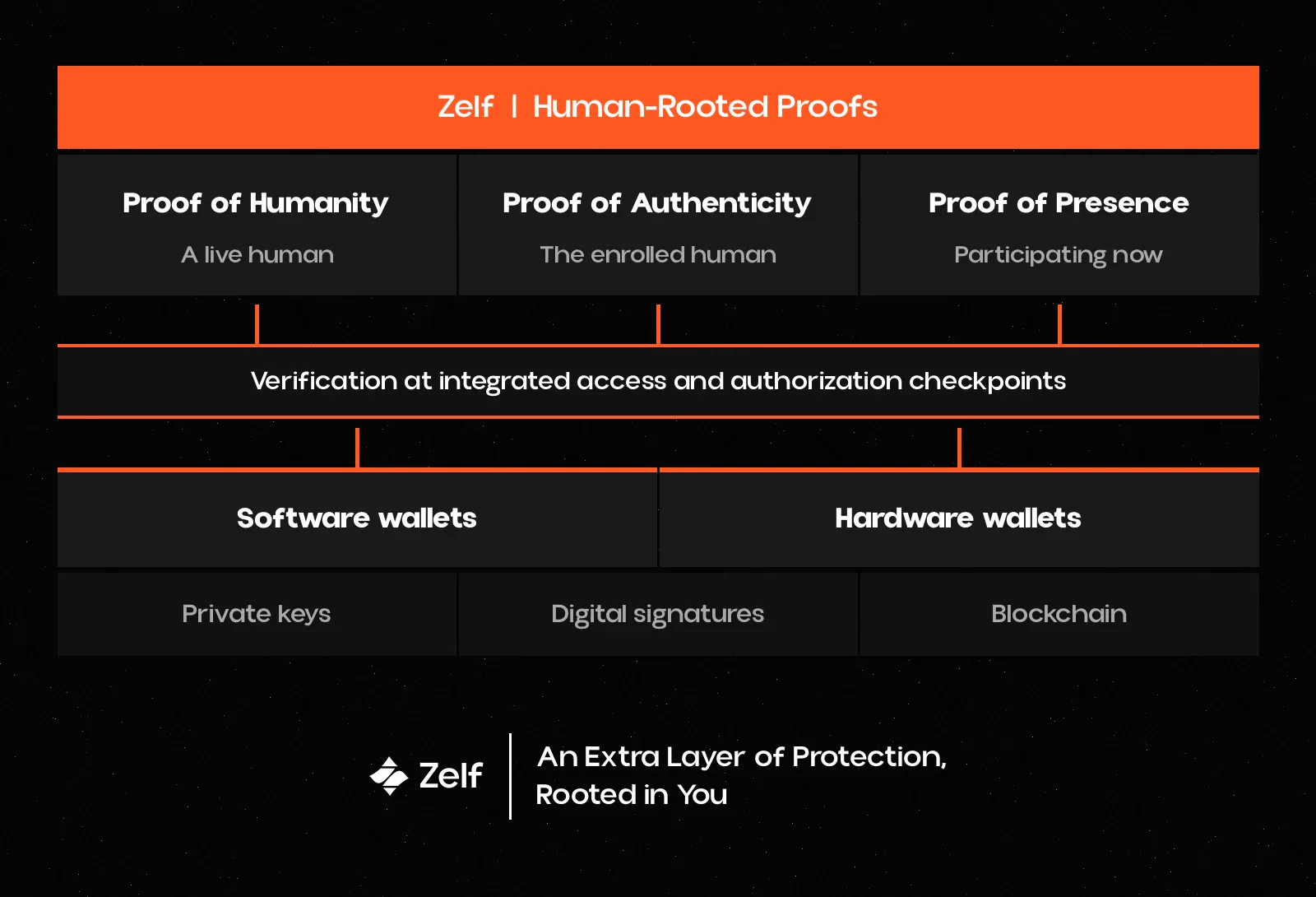
Zelf’s human-rooted proofs address a complementary question: who is participating in an authentication or authorization event? Where integrated, these checks can add protection to sensitive wallet-related actions instead of relying exclusively on previously established credentials.
Human verification adds protection at integrated checkpoints. It does not make underlying cryptography immune to mathematical breakthroughs. The diagram is conceptual and does not imply integration with any specific wallet.
Proof of Humanity checks for a live human.
Proof of Authenticity checks continuity with the enrolled person.
Proof of Presence checks fresh human participation in the particular event. HumanAuthn describes 1:1 verification with liveness through its API and SDK; the application must enforce the relevant result. [14]
For example, an integrated application could require fresh verification before releasing protected recovery data or approving a sensitive operation. That extra checkpoint is useful only if the protected flow actually requires it and alternative routes do not bypass it.
If a blockchain accepts a forged signature without consulting that application, the application’s biometric check would not stop the transaction. Biometric encryption,
fuzzy extractors, and human verification also depend on their own security assumptions. They should not be described as inherently immune to P = NP.
What Wallet Users Should Focus on Today
- Protect recovery phrases, private keys, and any required passphrase. Never disclose them to someone claiming to provide support.
- Use a strong, unique wallet password where applicable, and understand what it protects.
- Keep wallet software and device firmware updated through official channels.
- Check transaction details and token permissions before approving them, including on the hardware device where supported.
- Plan recovery before you need it, and understand which protections apply to each account.
Wallet security depends on both sound cryptography and careful control of access, recovery, and approvals. Human verification can strengthen integrated workflows, while research into cryptographic resilience addresses a different part of that foundation.
Sources
- Clay Mathematics Institute — P vs. NP
- Scott Aaronson — P versus NP survey
- Stephen Cook — The P versus NP Problem
- MetaMask — Recovery phrases and passwords
- Phantom — Create a recovery phrase wallet
- Trezor — What is a passphrase
- Ledger — How private keys are stored offline
- Ledger — Passphrase security
- MetaMask — Hardware wallet guide
- Phantom — Import an existing wallet
- NIST — Blockchain Technology Overview
- NIST — Quantum Computing Explained
- NIST — What Is Post-Quantum Cryptography
- HumanAuthn — Face verification with liveness