Back to Blog
The Ultimate Guide to Crypto Wallets in 2026
Explore the different types of crypto wallets available in 2026, including hot, cold, custodial, and non-custodial options. Discover how ZELF Wallet offers the safest way to protect your assets by leveraging proof of humanity.
ZELF Team•
TL;DR
- Crypto wallets manage the cryptographic keys that prove ownership and grant control over your digital assets on the blockchain.
- Custodial wallets hand key management to a third party, while self-custody wallets let you control your keys directly.
- Hot wallets stay connected to the internet for quick access; cold wallets store keys offline for stronger protection.
- Traditional self-custody still depends on hardware and seed phrases, creating a single point of failure if a device is compromised or a backup is exposed.
- ZELF Wallet introduces HumanAuthn, a biometric root of trust that replaces device-bound security with live human verification, making self-custody safer, simpler, and fully device-independent.
Why Wallet Security Matters More Than Ever
Cryptocurrency is rapidly establishing itself as a mainstream asset class and being adopted not only by early technologists, but also by institutional investors, global enterprises, and Wall Street. But with that growth comes a bigger challenge: keeping your crypto safe. In 2025 alone, crypto theft topped $3.4 billion, showing how costly security failures can be.
In 2026, securing crypto isn't just about strong passwords or hiding a seed phrase. Attackers are smarter, devices are always connected, and once a transaction is made, it can't be reversed. On top of that, traditional recovery methods are confusing and fragile, leaving many users at risk of permanently losing access to their funds.
This guide explores the main types of crypto wallets available today, how they work, and the risks associated with legacy architectures. You'll also see how ZELF Wallet uses proof of humanity to make self-custody simpler, safer, and more intuitive for crypto owners. Let's get into it!
What Is a Crypto Wallet?
A crypto wallet is a secure digital tool that allows users to store, send, and receive cryptocurrencies. Unlike a physical wallet, a crypto wallet does not store coins themselves. Instead, it manages the cryptographic keys that prove ownership and grant control over digital assets recorded on a blockchain.
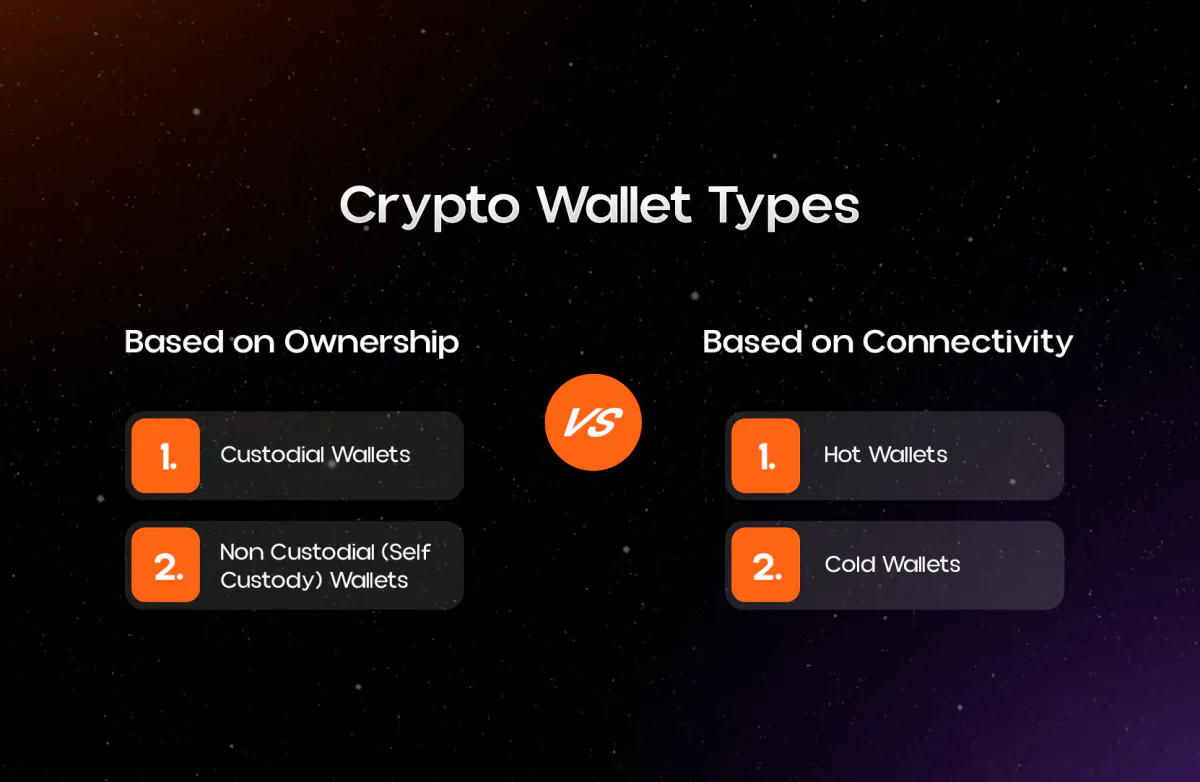
At its core, a crypto wallet is a bridge between the user and the blockchain networks. Whoever controls the cryptographic keys controls the assets. Based on this single principle, crypto wallets are categorized in two ways: by ownership and by connectivity.
Crypto Wallet Types Based on Ownership
1. Custodial Wallets
Custodial wallets hand over key management to a third party, such as an exchange or financial service provider. In this model, the company creates, stores, and manages the private keys on behalf of the user. In practice, custodial wallets resemble traditional banking more than decentralized finance.
Pros:
- Easy onboarding
- Password recovery and customer support
Cons:
- You don't truly own your crypto
- Funds can be frozen, seized, or lost if the custodian is compromised
Examples: Binance, Coinbase
2. Non-Custodial (Self-Custody) Wallets
Self-custody wallets let users control their cryptographic keys directly, typically through a private key or seed phrase. With self-custody, there is no intermediary. No one can move funds, block transactions, or recover access except the user. This model aligns with the original promise of crypto: sovereignty, censorship resistance, and permissionless ownership.
Pros:
- True ownership and permissionless control
- No intermediary can block transactions
Cons:
- If keys are lost or stolen, assets are irreversibly compromised
Traditional self-custody wallets rely on encrypting private keys locally on a device, making them device-centric architectures. This approach is commonly referred to as a hardware root of trust, where security of the wallet ultimately depends on the security of the device where the keys are stored.
Crypto Wallet Types Based on Connectivity
Self-custody wallets rely on a hardware root of trust to secure your private keys, and within this framework they fall into two main types: hot wallets and cold wallets.
1. Hot Wallets
Hot wallets store encrypted private keys on an internet-connected device such as a smartphone or computer. This makes them fast, convenient, and ideal for frequent transactions. However, because they are connected to the internet, they are more exposed to malware, phishing attacks, operating system vulnerabilities, and device compromise.
Examples: MetaMask, Trust Wallet, Exodus
Pros: Easy access and usability
Cons: Greater exposure to phishing, malware, and device compromise
2. Cold Wallets
Cold wallets store private keys entirely offline, often using dedicated hardware devices or even paper backups. Because they never touch the internet, they provide a higher level of security. The tradeoff is usability: cold wallets are less convenient and slower to use, especially for everyday transactions.
Examples: Ledger, Trezor, Safepal
Pros: Strong security
Cons: Less convenient and still dependent on seed phrase backups
Limitation of Traditional Self-Custody Wallets
Traditional self-custody has always rested on one core idea. Private keys need to live somewhere, and they need to stay safe for as long as the wallet exists. Hot wallets and cold wallets take different paths, but they share this same foundation. Your security depends on hardware, backups, and private keys that never change.
That creates a fragile point in the system. If a device gets compromised or stolen, or if a seed phrase leaks even once, the wallet stays exposed from that moment on. The entire setup is only as strong as the hardware root of trust that protects those keys.
This is the architectural limitation that modern wallet designs are now trying to overcome. Instead of tying trust to a device, new models look for ways to anchor it to the user. That is the shift introduced by ZELF Wallet and its HumanAuthn technology (first of its kind), which replaces device-centric trust with human-centric trust through a biometric root of trust. The goal is to keep self-custody intact while removing the single point of failure that has held traditional wallets back.
Secure Your Crypto with ZELF: Next-Generation Self-Custody Wallet Featuring Biometric Root of Trust
ZELF Wallet bridges the best of both worlds by combining the convenience of hot wallets with the security of cold wallets. It does this through a new platform primitive called HumanAuthn. This system standardizes how humans authenticate themselves to cryptographic systems by shifting the trust anchor away from devices and toward human presence.
Traditional wallet architectures rely on a hardware root of trust, where security is anchored to a specific device. In contrast, HumanAuthn introduces a biometric root of trust, where cryptographic access is bound to live human authentication rather than stored secrets or hardware-bound keys.
How HumanAuthn Works: A Technical Breakdown
HumanAuthn is not just facial recognition. It is a cryptographic authentication primitive designed for decentralized systems.
1. Enrollment
During enrollment:
- A live biometric input is captured with liveness detection.
- Simultaneously, high-entropy random material is generated.
- This entropy contains no biometric information.
- The biometric signal and entropy are combined to derive ephemeral cryptographic key material.
This key material encrypts the user's private keys (seed phrases) into a privacy-preserving credential called a ZELF ID.
Important security properties:
- No biometric templates are stored.
- No raw biometric data is retained.
- No long-lived cryptographic keys are created at rest.
- Private keys are never exposed during this process.
The result is a fully encrypted, portable cryptographic identity that represents secure self-custody.
2. Authentication
During authentication:
- A new live biometric input is captured.
- The system combines this input with previously generated entropy.
- If and only if liveness and biometric matching succeed, the same ephemeral cryptographic key material is reconstructed.
This reconstructed key decrypts the ZELF ID and grants access.
If biometric verification fails:
- The ephemeral key cannot be reconstructed.
- Decryption becomes mathematically impossible.
There are:
- No passwords to steal.
- No static credentials to phish.
- No private keys exposed during authentication.
This approach dramatically reduces common crypto wallet attack vectors such as phishing approvals, credential stuffing, and device compromise.
3. Storage
ZELF ID is:
- A QR-code-compatible encrypted binary object.
- Stored on decentralized systems such as blockchain networks or IPFS.
- Fully encrypted and privacy-preserving.
Because it contains no biometric data and no usable private keys in plaintext form:
- It can be publicly stored.
- It can be replicated across systems.
- It can be retrieved from any compatible device.
Access is only possible after successful biometric liveness verification of the enrolled user.
This makes ZELF Wallet:
- Device-independent
- Cloud-independent
- Provider-independent
Self-custody is no longer tied to hardware. It is tied to you.
How to Identify a Secure Crypto Wallet in 2026
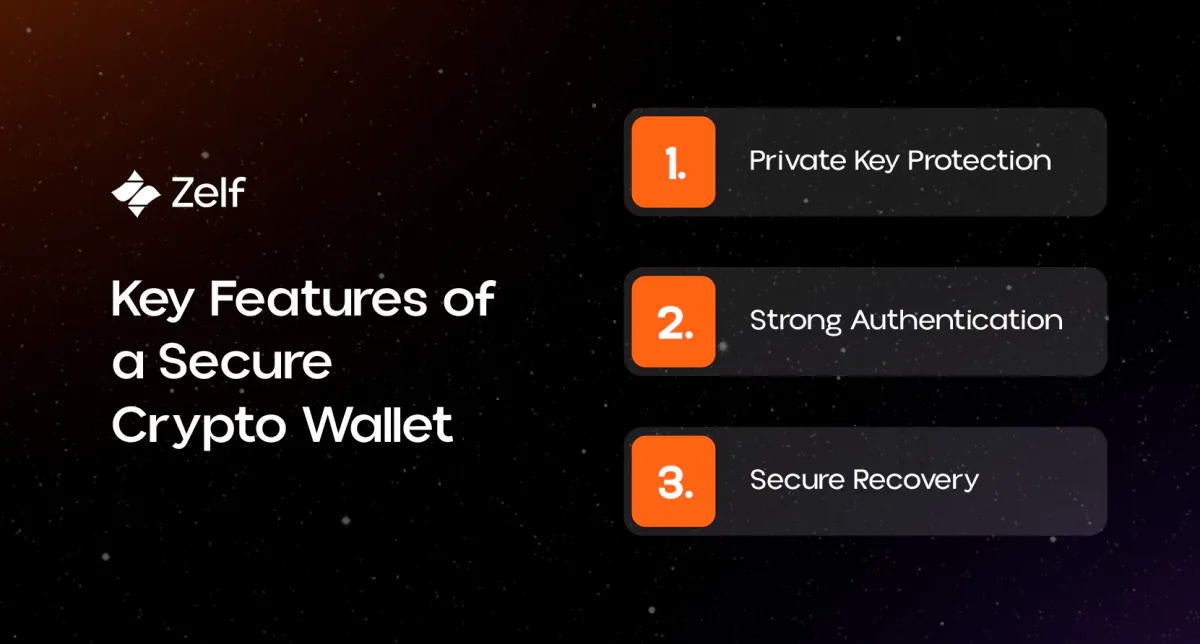
Not every wallet that claims to be secure truly is. In 2026, real security goes beyond basic encryption or offline storage. A secure crypto wallet must protect private keys intelligently, verify identity reliably, and allow safe recovery without putting user control at risk.
Below are the essential features to look for when choosing a truly secure crypto wallet in 2026:
Private Key Protection
Private keys are the backbone of crypto ownership. Whoever controls the private key controls the assets. That is why protecting those keys is non-negotiable. Traditional self-custody wallets typically protect private keys through local encryption, isolated storage, or secure signing environments. While these methods offer protection, they still depend on static keys stored somewhere, often tied to a specific device. If that device is compromised or the backup phrase is exposed, the risk increases significantly.
ZELF Wallet takes a different route. Instead of keeping static private keys stored at rest, it generates a biometric verifiable credential known as a ZELF ID. This credential encrypts the user's private keys or seed phrases and stores them in decentralized storage.
The result is powerful. Private keys are never exposed during authentication or transaction approval. By shifting from a hardware root of trust to a biometric root of trust, ZELF ensures that even if a device is compromised, the user's portfolio remains cryptographically protected.
Strong Authentication
A secure wallet must reliably verify that it is really you before granting access. Historically, this has relied on passwords or PINs, methods that are vulnerable to phishing, reuse, and human error. In a system where transactions cannot be reversed, weak authentication can result in permanent loss.
Modern wallets are moving toward authentication models that are both safer and more user friendly. ZELF Wallet uses liveness-based authentication, which enables proof of humanity rather than proof of possession. This approach reduces dependence on static secrets that attackers can steal or replicate.
A live biometric input is combined with stored random entropy to reconstruct ephemeral cryptographic key material, which is then used to decrypt the ZELF ID. This prevents unauthorized access without adding friction for the user, with no passwords to remember and no static credentials to expose.
Secure Recovery
Recovery is just as critical as everyday authentication. In most self-custody wallets, users are solely responsible for protecting their seed phrase. If it is lost, damaged, or forgotten, access to funds is permanently lost, making recovery failure one of the most common causes of asset loss in crypto.
Modern wallets must offer recovery mechanisms that preserve self-custody while protecting users from irreversible mistakes. This means reducing reliance on centralized backups and avoiding a single point of failure tied to one device or secret.
ZELF is among the modern self-custody wallets that support strong key recovery. Instead of depending on centralized cloud backups, users can retrieve their ZELF ID directly from decentralized storage and authenticate through biometric liveness. Recovery becomes safer, decentralized, and independent of any single device or provider.
The Bottom Line
A secure crypto wallet in 2026 must do more than store keys. It must protect them intelligently, verify identity reliably, and offer recovery without introducing new risks.
Private key protection, strong authentication, and secure recovery are no longer optional features. They are the foundation of responsible self-custody.
Wallets that combine advanced cryptography with human-centered design are setting the new standard. And in an ecosystem where mistakes are permanent, that standard matters.
Try ZELF for Peace of Mind
If you want a secure crypto wallet that brings together advanced cryptographic security, seamless recovery, and an intuitive user experience, ZELF Wallet is designed with that balance in mind. It gives you full control over your assets while removing the constant fear of lost keys, exposed credentials, or complicated backups.
With biometric root of trust, decentralized storage, and strong key recovery, ZELF protects your portfolio without adding unnecessary friction. You stay in control, and your security stays intact.
Frequently Asked Questions (FAQs)
What is the biggest risk to crypto wallet security?
The biggest risks include private key or seed phrase exposure, phishing attacks, and scams that trick users into approving malicious transactions. Since crypto transactions are irreversible, even one mistake can lead to permanent loss of funds.
What happens if I lose access to my wallet?
Traditional wallets rely entirely on seed phrases. If the phrase is lost or forgotten, access to funds is usually gone forever. Proof of humanity self-custody wallets like ZELF allow users to recover access through biometric liveness verification, without needing to store or remember a seed phrase.
What is ZELF ID and how does it improve wallet security?
ZELF ID is a privacy-preserving verifiable credential powered by HumanAuthn. It securely encapsulates private keys without storing biometric data. Access is granted only through live biometric verification combined with randomness-bound cryptography, which significantly reduces the risk of unauthorized access.
What makes ZELF the best wallet for crypto?
ZELF stands out by replacing hardware-based trust with biometric liveness as a cryptographic primitive. It removes the risks associated with exposed seed phrases, supports decentralized recovery, and delivers a simple user experience while maintaining strong self-custody security.
Does ZELF store or track my biometric data?
No. ZELF does not store facial images, biometric templates, or raw biometric data. Biometric input is used only during authentication to reconstruct ephemeral cryptographic key material. Once complete, no biometric information is stored or transmitted.
Can I use ZELF on multiple devices?
Yes. ZELF is device-agnostic by design. Since your ZELF ID is stored in decentralized storage and not tied to a single device, you can securely access your wallet from any compatible device after successful biometric liveness verification.
crypto-walletself-custodybiometricsecuritywallet-guidehumanauthn